Quality, testing & patents
Here is what we hold — and what we do not.
Plenty of cap suppliers put “FDA approved” and “food grade certified” on a homepage with nothing behind it. We would rather you knew exactly where we stand before you spend a call on us.
What we hold
4 granted patents & copyrights
Three utility-model patents and one software copyright, all issued in China. Every number below is published in full so you can look it up.
No food-contact certification yet — see the section below.
Patents & registrations
What we hold, and what it covers.
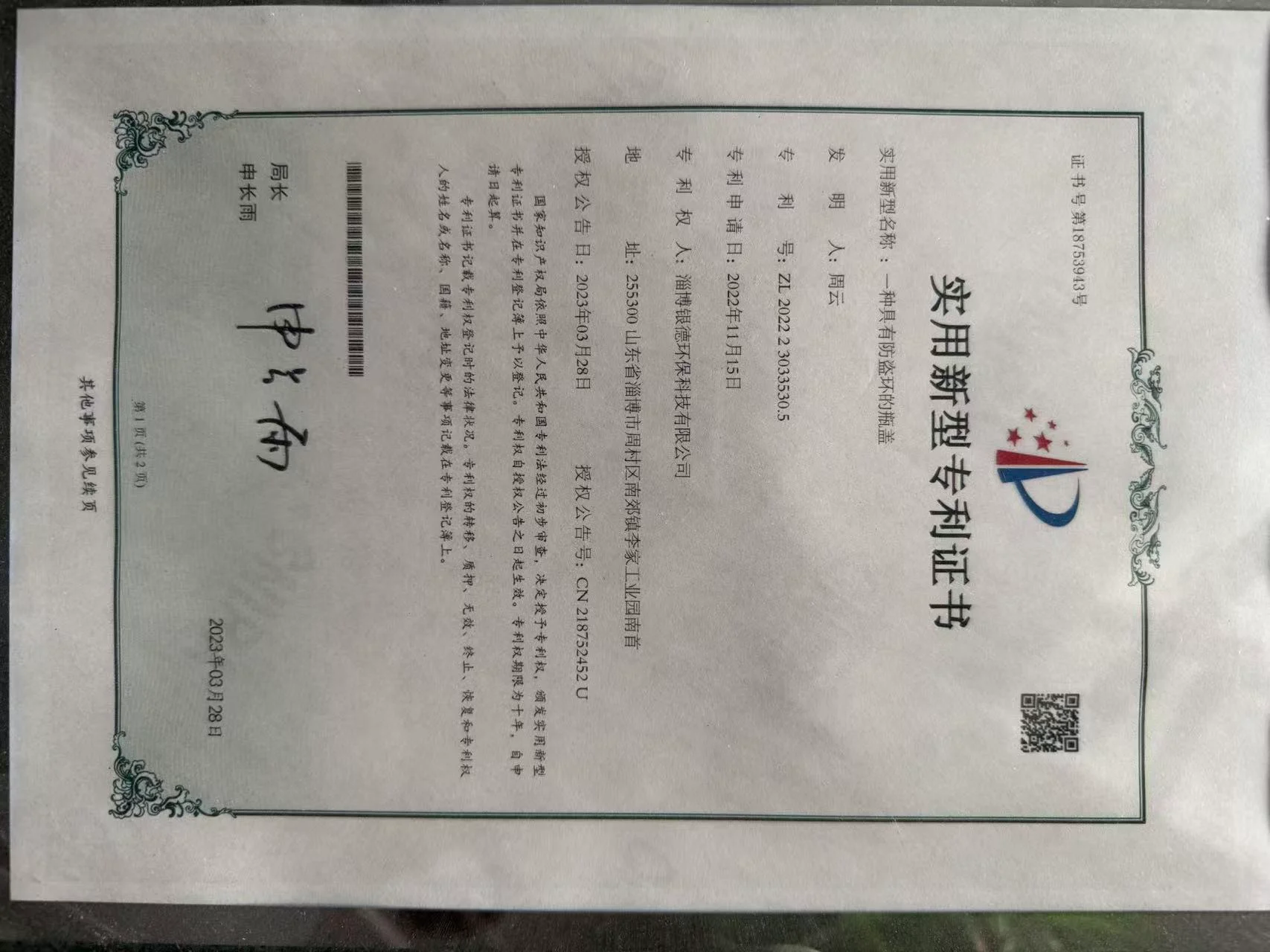
- ZL 2022 2 3033530.5
Utility-model patent — tamper-evident bottle cap
Granted by CNIPA on 28 March 2023, publication CN 218752452 U. Covers the bridge geometry of the tamper-evident ring.
- ZL 2022 2 2829413.3
Utility-model patent — high-precision cap ring-slitting machine
Granted by CNIPA on 17 February 2023, publication CN 218488588 U. The slitting equipment we built for our own line.
- ZL 2022 2 2829412.9
Utility-model patent — feed assembly for cap moulding machines
Granted by CNIPA on 28 March 2023, publication CN 218748806 U. Feeding mechanism used on our moulding cells.
- 2024SR1475743
Software copyright — plastic product design and manufacturing platform
Registered with the Copyright Protection Centre of China on 9 October 2024, certificate 软著登字第13879616号.
Where we fall short
Three gaps, stated before you ask.
If any of these is a blocker for your market, say so on the first email and we will tell you honestly whether we can close it in your timeline.
- 01
No third-party food-contact report yet
We hold no overall-migration or specific-migration report from an accredited laboratory. If your market needs one — and the EU and the US both will — we will run the test at a lab you nominate and send you the report. The cost and the schedule are quoted before we start.
- 02
No FDA, EU 10/2011 or LFGB declaration yet
We are not going to publish a declaration we cannot evidence. What we can tell you today is the exact resin grade and the additive package, so your own compliance team can assess it.
- 03
No ISO 9001 certificate yet
Our process controls are the ones described above and they are real, but they are not third-party audited. If a certified quality system is a hard requirement for you, we are not the right supplier this year.
Test programme
What actually gets measured, and by whom.
The “where” column is the important one. In-house means our own bench and our own record — useful, but it is not a third-party report and we are not going to present it as one.
| Test | Method | Requirement | Where |
|---|---|---|---|
| Removal torque | ASTM D3198 | Within the band agreed for your neck and filling line | In-house, sampled every run |
| Application torque | ASTM D3198 | Set so the cap seals without cracking the finish | In-house, sampled every run |
| Tamper band bridge strength | In-house method | Band separates at every bridge on first opening | In-house, sampled every run |
| Leakage, inverted | In-house method | No leak after 24 hours inverted, filled | In-house, sampled every run |
| Dimensional check | Gauge and caliper against the drawing | Within the tolerance on the approved drawing | In-house, first-off and in-process |
| Drop test, filled unit | ASTM D2463 | No leak or fracture after drop | In-house, on request |
| Top load | ASTM D2659 | No collapse below the agreed load | In-house, on request |
| Overall migration | EU 10/2011 Annex V · GB 31604.8 | ≤10 mg/dm² | Not yet run — accredited lab, on request |
| Specific migration | EU 10/2011 Annex I | Within the SML for each listed substance | Not yet run — accredited lab, on request |
| Heavy metals | GB 4806.7 · EU 10/2011 | Below the declared limits | Not yet run — accredited lab, on request |
Torque bands are not a single number we can publish — they depend on your neck finish, your filling line and whether the product is hot-filled. Send us the bottle and the line speed and we will recommend one.
Process control
Control starts at the resin, not at the carton.
None of this is exotic. It is the set of checks that stops the two failures that actually reach a bottler: a ring that will not break cleanly, and a cap that leaks once the pallet has been stacked.
Virgin resin only
Food-contact grade polypropylene and polyethylene, bought as virgin material. We do not blend in reground or recycled resin on food-contact parts, because you cannot document what went into it.
First-off approval
The first shells off a tool are checked against the approved drawing before the run is released. A mould that has drifted is caught at piece one, not at carton one thousand.
In-process torque sampling
Removal and application torque are sampled through the run, because a cap that seals on the bench and spins on your filling line is the failure that actually costs you money.
Sealed liners before the carton closes
Caps go into a sealed PE liner inside every carton, so nothing picks up dust or moisture between our floor and your filler.
Documentation request
Tell us the market and we will tell you the gap.
Send the country you sell into and what goes in the bottle. We will come back with the resin grade, what we can evidence today, and a quote for any third-party test your market requires.